
Introduction
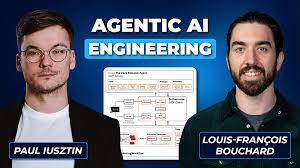
Artificial Intelligence is no longer just about building chatbots or training machine learning models. The next evolution is agentic systems—AI that can reason, plan, execute tasks, and improve autonomously. One of the most comprehensive educational resources shaping this new frontier is Paul Iusztin – Agentic AI Engineering.
This program is designed for developers, AI enthusiasts, and forward-thinking engineers who want to move beyond traditional machine learning pipelines and enter the era of autonomous AI systems. Instead of simply prompting language models, it focuses on designing structured, production-ready AI agents that interact with tools, APIs, memory systems, and complex workflows.
If you’re serious about building scalable AI products instead of experimenting with surface-level tools, this is where real engineering begins.
Who Is Paul Iusztin?



Paul Iusztin is known for his work in applied artificial intelligence, production-grade AI systems, and practical AI architecture. Unlike purely academic educators, his approach emphasizes real-world deployment, scalability, and system reliability.
His teaching philosophy revolves around:
Building AI systems that actually work in production
Combining theory with practical implementation
Engineering discipline over hype
Clean architecture and modular AI systems
This makes his agentic engineering framework particularly valuable for professionals who want long-term leverage in the AI industry.
What Is Agentic AI Engineering?
Before diving deeper, let’s clarify what “agentic AI” really means.
Traditional AI systems:
Take input
Produce output
End execution
Agentic systems:
Observe environment
Plan actions
Use tools
Maintain memory
Execute tasks autonomously
Adapt based on feedback
In other words, they behave more like software entities with goals rather than simple prediction engines.
The core idea behind Paul Iusztin – Agentic AI Engineering is to teach developers how to build these autonomous AI systems responsibly and efficiently.
Core Philosophy of the Program
The training is structured around five core pillars:
1. AI as a System, Not a Prompt
Instead of relying on prompt tricks, the focus is on architecture:
Modular components
Agent orchestration
Clear separation of reasoning and execution
Scalable infrastructure
2. Tool-Augmented Intelligence
Modern AI agents are powerful when connected to:
APIs
Databases
Vector stores
Browsers
External automation systems
The program emphasizes how to design agents that decide when and how to use tools.
3. Memory & Context Engineering
Long-term and short-term memory structures are fundamental:
Conversation memory
Knowledge retrieval
Context window optimization
Embeddings and vector databases
Without memory design, autonomous agents quickly become unreliable.
4. Reliability & Evaluation
Agent systems must be:
Testable
Measurable
Debuggable
Deterministic where needed
This is a major difference between hobby AI builders and real AI engineers.
5. Production Deployment
The final layer involves:
Monitoring
Logging
Scaling
Cost optimization
Security best practices
This ensures systems don’t just work in demos—but in live environments.
Curriculum Breakdown
While the structure may evolve, the core learning journey generally includes:
Foundation Layer
Large Language Models fundamentals
Prompt engineering principles
Transformer-based reasoning models
Context limitations
Agent Architecture
Single-agent design
Multi-agent systems
Planner-executor architecture
Task decomposition strategies
Tool Integration
API calling
Structured outputs
Function calling frameworks
External data retrieval
Memory Systems
Vector databases
Embedding strategies
Retrieval-augmented generation (RAG)
Long-term knowledge persistence
Autonomous Workflows
Self-reflection loops
Feedback-based refinement
Goal-driven execution
Agent chaining
Production & Scaling
Infrastructure design
Cloud deployment
Performance optimization
Observability & logging
This layered structure makes it easier to move from beginner experimentation to professional-grade systems.
Practical Projects & Real-World Applications
One of the biggest strengths of this program is its practical orientation. Students don’t just learn theory—they build systems such as:
AI research agents
Autonomous customer support bots
AI data analysts
Multi-step workflow automation systems
Code generation assistants
Knowledge retrieval agents
These projects reflect real industry demand. Businesses are increasingly seeking engineers who can design AI agents that automate workflows instead of just answering queries.
Why Agentic Engineering Matters in 2026 and Beyond
AI is shifting from static tools to dynamic systems.
Companies now want:
AI employees
Automated research assistants
Intelligent operations managers
AI copilots integrated into workflows
Understanding how to build agent-based systems gives engineers a massive competitive advantage.
Instead of being replaced by automation, you become the architect of automation.
Key Technical Skills Developed
After mastering this framework, learners typically gain proficiency in:
LLM orchestration
Structured prompting
RAG systems
Vector database integration
Tool usage pipelines
API design for AI agents
Error handling in AI loops
Autonomous workflow engineering
These skills are significantly more advanced than basic AI API usage.
Who Should Enroll?
Paul Iusztin – Agentic AI Engineering is ideal for:
Software engineers transitioning into AI
ML engineers upgrading to agent systems
Startup founders building AI products
Automation specialists
Backend developers wanting AI integration
It is less suitable for complete beginners with no programming experience. A foundation in Python or backend systems is highly recommended.
Career Impact & Opportunities
Mastering agentic systems opens doors to roles such as:
AI Systems Engineer
LLM Architect
AI Automation Engineer
Applied AI Engineer
AI Infrastructure Developer
These roles are among the fastest-growing categories in tech.
As more companies adopt AI agents for internal operations, demand for engineers who understand system-level AI architecture will only increase.
Competitive Advantage Over Basic AI Courses
Many AI courses focus on:
Prompt tricks
Chatbot building
Simple API integration
What sets this program apart is its focus on:
Structured design patterns
Production engineering
Reliability testing
Long-term system sustainability
It treats AI as serious software engineering—not experimentation.
Learning Experience
The structure typically includes:
In-depth video explanations
Code walkthroughs
Architecture diagrams
Hands-on assignments
Real-world deployment examples
This balance between theory and practice helps solidify deep understanding rather than surface-level familiarity.
Long-Term Value
The AI landscape changes rapidly. However, system-level principles remain constant:
Architecture patterns
Modular design
Abstraction layers
Reliability engineering
By focusing on these fundamentals, the framework maintains long-term relevance even as models evolve.
You’re not just learning how to use a tool—you’re learning how to design intelligent systems.
Final Thoughts
Artificial Intelligence is entering its most transformative era. The shift from reactive tools to autonomous agents represents a structural change in how software is built and operated.
Paul Iusztin – Agentic AI Engineering provides a comprehensive roadmap for navigating this transformation. Instead of teaching shortcuts or surface techniques, it emphasizes:
Deep system understanding
Structured architecture
Tool-based intelligence
Memory-driven reasoning
Production reliability
For developers and entrepreneurs aiming to stay ahead of the curve, mastering agentic AI engineering is not optional—it’s strategic.
If your goal is to build real AI products, automate complex workflows, and engineer intelligent systems that operate autonomously, this framework delivers the foundation required to do it properly.



Reviews
There are no reviews yet.